
Who Fixes Gas Fireplaces in Phoenix? The Honest Answer
Not a plumber, not an HVAC tech, not your handyman. Here’s who’s actually qualified to fix a gas fireplace in the Valley — and how to spot the contractors who’ll guess instead of diagnose.
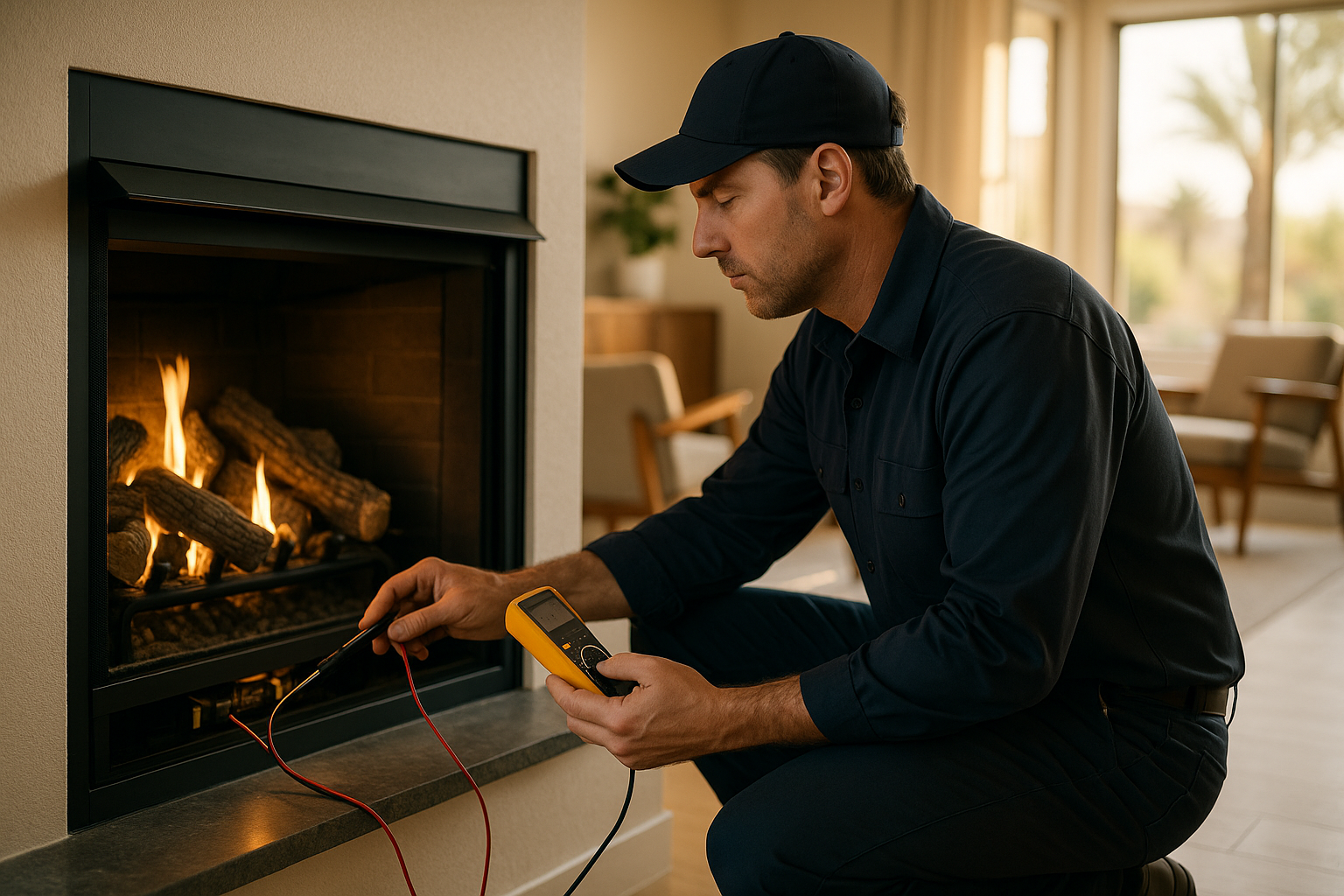
If you’ve ever Googled “who fixes gas fireplaces near me” and gotten back a list of plumbers, HVAC techs, and general handymen, you’ve experienced the central confusion of this trade. Gas fireplaces look like a plumbing job (gas lines) and an HVAC job (combustion + venting) but the actual repair work belongs to neither.
Here’s the real answer, written by the people who get called second — after the plumber says it’s not a plumbing issue.
The right contractor is a chimney-and-fireplace specialist
Specifically: a licensed contractor with both NFI (National Fireplace Institute) or CSIA (Chimney Safety Institute of America) certification, an active Arizona ROC license, and a gas-line endorsement. That’s three credentials, and they almost never overlap with other trades.
Why all three? Because gas fireplace repair is one job that touches three different regulatory domains:
- Combustion controls. Thermocouples, thermopiles, gas valves, igniters — the parts that make the flame stay lit. NFI/CSIA training covers these specifically by brand (Heatilator, Heat & Glo, Napoleon, Regency, Valor, Majestic, Mendota, Kozy Heat, Empire, Lopi, Pacific Energy, Jotul).
- Venting and refractory. The flue, the firebox lining, the cap, the seal where the unit meets the chimney structure. This is where chimney-side training matters.
- Gas-line work. Shut-off valves, leak testing, pressure verification. Arizona requires a separate ROC endorsement to work on gas lines — not every fireplace shop has it.
A real chimney-and-fireplace specialist holds all three. We do, and the Phoenix metro has maybe a dozen others who do too.
Plumbers, HVAC techs, and handymen — what each gets wrong
Each adjacent trade gets called for gas fireplace work, and each fails differently. Worth knowing because the wrong contractor can make the next repair more expensive.
- Plumbers handle the gas line from the meter to the appliance shut-off valve. That’s where their training stops. A good plumber will tell you on the phone that the actual fireplace work isn’t theirs — the lazy one will show up, charge a $125 service call, and refer you to us anyway.
- HVAC technicians work on heating systems where the combustion happens inside a sealed chamber connected to ductwork. Direct-vent and B-vent fireplaces use entirely different combustion controls, and the parts (thermopiles, refractory panels, electrode kits) aren’t in their parts inventory.
- General handymen sometimes try gas fireplace work because the repair “looks simple.” When the diagnosis is wrong, the homeowner ends up paying once for the handyman attempt and again for the real fix. We get called for this regularly — the handyman replaces a perfectly good thermocouple, the pilot still won’t stay lit, and we discover the actual problem was a fouled pilot orifice ($125 to clean) or a low-voltage thermopile ($249).
What a real diagnostic call should cover
If a contractor shows up and starts swapping parts before testing, walk away. A proper gas fireplace diagnosis follows this order:
- Pilot light test. Does it light? Does it stay lit when the pilot button is released? Does the main burner ignite?
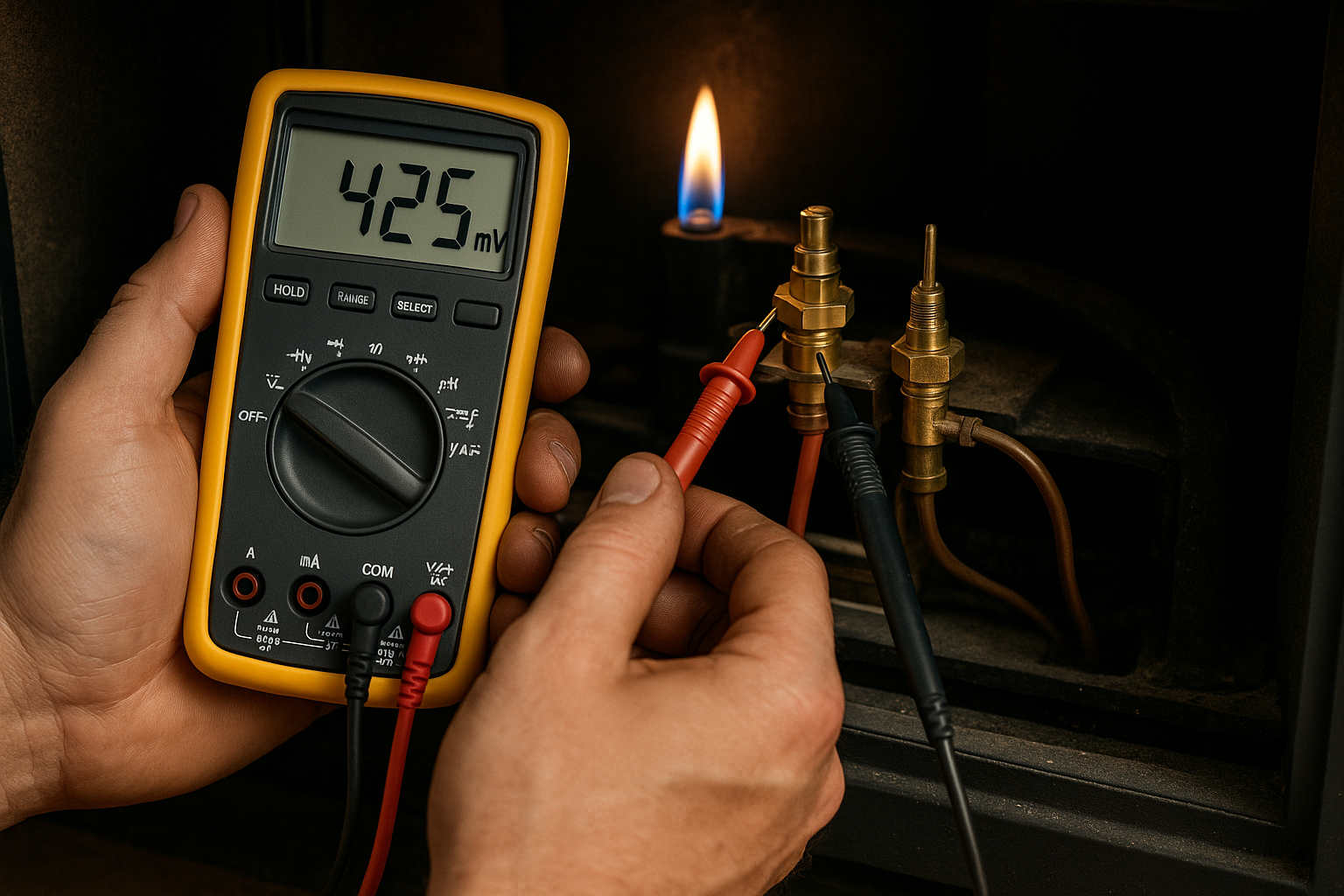
- Voltage check. Multimeter on the thermopile reading. A healthy thermopile delivers 350-750 millivolts. Below 350mV is failing.
- Gas pressure check. Inlet pressure at the appliance valve. Should be ~3.5″ WC for natural gas, ~10-11″ WC for propane.
- Visual on the burner pan, refractory, igniter, and module. Yellow flame, soot accumulation, cracked refractory panels — all visual diagnostics that take 5 minutes.
By the end of a 30-minute diagnostic, the technician should be able to tell you exactly what’s failing and quote the part + labor in writing before any work begins. Our diagnostic is $99 and credited toward the repair.
The five repairs that cover 80% of gas fireplace calls
Almost every gas fireplace repair we do falls into one of these five buckets. Knowing which one you’re dealing with helps you tell whether the quote you’re getting is fair.
- Thermocouple replacement — ~$189. Pilot lights but won’t stay lit when you release the button. Most common repair on units 5+ years old. Part is $20; labor + diagnostic time is the rest.
- Thermopile replacement — ~$249. Pilot stays lit, but the main burner won’t ignite or shuts off after a few minutes. Thermopile generates the millivolts that hold the gas valve open during main burner operation.
- Igniter / electrode swap — $250-$350. Electronic ignition fails — the click of the spark generator is missing, or the spark is visible but the gas doesn’t catch.
- Gas valve replacement — $400-$650. The main control valve fails. Less common but more expensive because the part is $200-$300 and the install requires gas-line work.
- Pilot orifice clean-out — $125-$185. Pilot won’t light or burns yellow. Dust, spider webs, or insect bodies block the orifice. We disassemble, clean, and re-tune the air mix.
If the contractor you’re calling can’t tell you which of these five they’re quoting before starting work, find a different contractor.
Three phrases that mean walk away
Specific phrases we hear from homeowners describing previous failed-contractor experiences. If you hear any of these, the contractor is guessing — not diagnosing.
- “It’s probably the thermocouple, let me just swap it and see.” A real diagnosis doesn’t swap parts to see if they fix the problem. The contractor either tests the part with a multimeter or has a clear symptom-to-failure mapping.
- “Gas fireplaces are pretty simple, I can do it.” Gas fireplaces use brand-specific ignition modules, refractory panels, and venting that vary wildly between Heatilator and Heat & Glo and Napoleon. “Pretty simple” means “I don’t know.”
- “Just replace the whole unit, it’ll be cheaper than fixing this.” Almost never true. A $189 thermocouple fix vs. a $4,500-$9,000 insert replacement — those are very different numbers. We replace units when the unit is genuinely dead (cracked firebox, condemned refractory, brand discontinued and no parts available) — not because we don’t want to do the diagnostic work.
Where we work in the Valley
Direct line: (602) 536-8034. Diagnostic is $99 and credited toward the repair. Same-week appointments most weeks.
Cities we cover: Phoenix · Scottsdale · Mesa · Tempe · Chandler · Gilbert · Glendale · Peoria · Paradise Valley.
Related reading: How much does chimney repair cost in Phoenix? for the chimney side of the same kind of pricing breakdown.
Frequently Asked Questions
Who fixes gas fireplaces in Phoenix?
A licensed chimney-and-fireplace specialist with NFI or CSIA certification, an active Arizona ROC license, and a gas-line endorsement. Not a plumber, not an HVAC technician, not a general handyman — gas fireplace repair sits at the intersection of three regulated trades and requires all three credentials. Arizona Chimney Pros covers the entire Phoenix metro.
Who do you call to fix a gas fireplace?
Call a chimney-and-fireplace contractor in your service area. Search “gas fireplace repair [your city]” rather than “gas appliance repair” or “fireplace installer” — those return different trades. In Phoenix, look for contractors with both NFI/CSIA certification and a current ROC license. Avoid general handymen, plumbers, and HVAC techs for gas fireplace work.
Can a plumber fix a gas fireplace?
Usually not. Plumbers handle the gas line up to the appliance shut-off valve — the work on the fireplace itself (thermocouples, valves, refractory panels, ignition modules) requires combustion-controls training that isn’t part of plumbing licensing. A good plumber will tell you on the phone they can’t do the repair and refer you to a chimney-and-fireplace specialist.
How much does it cost to fix a gas fireplace in Phoenix?
Most repairs run $189 to $650 in the Phoenix metro. Thermocouple replacement is ~$189. Thermopile is ~$249. Igniter/electrode swap is $250-$350. Gas valve replacement is $400-$650. Pilot orifice clean-out is $125-$185. Diagnostic visit is $99, credited toward any repair. We quote in writing before any work begins.
How do I fix a gas fireplace that won’t light?
First check the basics: gas valve open, breaker not tripped, pilot light visible. If the pilot won’t stay lit when you release the pilot button, it’s usually the thermocouple ($189 fix). If the pilot stays lit but the main burner won’t ignite, it’s the thermopile ($249) or the igniter ($250-$350). Don’t keep trying to relight a fireplace that won’t stay lit — you can build up unburned gas in the firebox. Call a specialist.
How do I find a good gas fireplace repair contractor?
Three checks. (1) ROC license number on their website — verify at roc.az.gov. (2) NFI or CSIA certification — ask which technicians hold it and what year. (3) Diagnostic-first pricing — if they quote a repair sight-unseen over the phone, they’re guessing. Real contractors charge a small diagnostic fee ($75-$125) credited toward the repair, and only quote after testing.
How long does gas fireplace repair take?
Most repairs are completed in a single visit, 1-3 hours total. Thermocouple swap: 30-45 minutes. Thermopile swap: 45 minutes. Igniter/electrode: 1 hour. Gas valve: 1.5-2 hours (gas-line work adds time). Pilot orifice clean-out: 1 hour. Only multi-part jobs (e.g., valve + thermopile + refractory panel) require a second visit, and we tell you that upfront.