Chimney Leaking in Scottsdale, AZ — Water Damage Repair
Anthem’s master-planned homes all came with identical Heat & Glo units back in the early 2000s. We’ve rebuilt enough of them now that we stock the exact gasket set and pilot assembly in the truck.
Now you're wondering how bad it really is and whether using the fireplace again is even safe. That's a reasonable thing to worry about, and you're right to take it seriously.
Chimney leaks in Scottsdale almost always trace back to one of three things: a cracked chimney crown at the very top, failed flashing where the chimney meets your roofline, or a cap that's either missing or has taken enough abuse to stop doing its job. The tricky part is that the water rarely enters where it shows up. It travels — sometimes several feet — before it drips into the firebox or stains the surrounding masonry.
We see this exact situation throughout Scottsdale every monsoon season, and the good news is that most leaks are fully repairable in a single visit. You don't need a full chimney rebuild. You need someone who can get up there, find the actual entry point, and seal it correctly the first time.
What Causes This Problem?
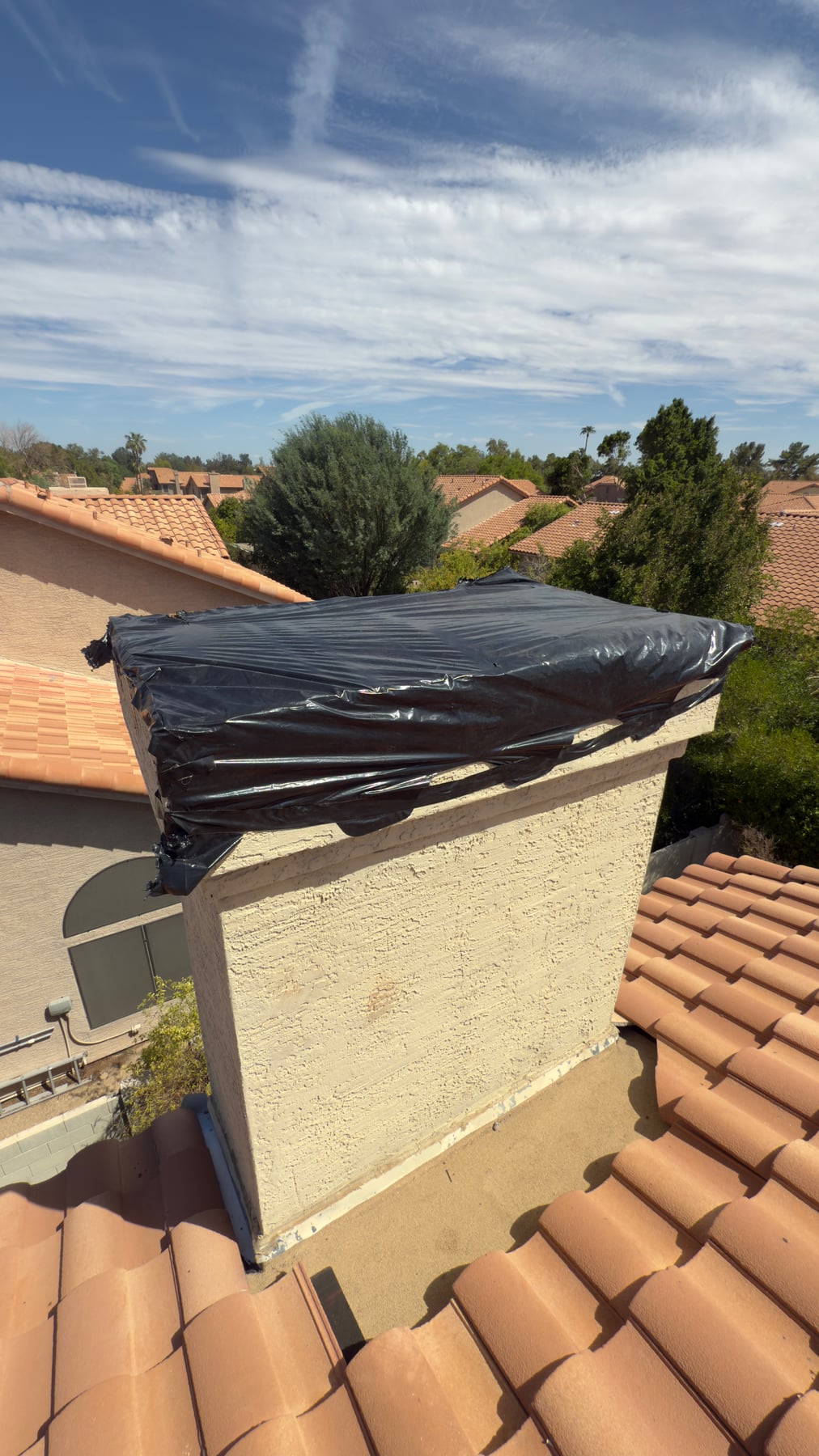
Water finds its way into a chimney through a handful of specific failure points. When we get the call about a wet firebox or water staining around a chimney in Scottsdale, we're mentally running through the same short list of culprits before we even arrive. Here's what we're looking for and what each one means in plain terms.
- Cracked chimney crown — The crown is the concrete or mortar cap that covers the top of the chimney structure around the flue liner. When it cracks from heat cycling and UV exposure, rainwater runs directly into the masonry below it.
- Failed or improperly installed flashing — Flashing is the metal seal between the chimney and the roof surface. When it pulls away, rusts through, or was never properly counter-flashed into the mortar joints, water follows the chimney straight through the roofline.
- Missing, damaged, or undersized chimney cap — The cap sits over the flue opening itself. Without a functional cap, monsoon rain falls directly into the flue. Even a slightly undersized cap lets wind-driven rain in from the sides.
- Deteriorated mortar joints — The horizontal mortar lines between chimney bricks erode over time, especially on the exposed top courses. Once the mortar is porous, water wicks in and migrates down through the stack.
- Cracked or spalled brick on the chimney exterior — Scottsdale's thermal expansion and contraction causes face bricks to crack or pop. Compromised brick face absorbs water directly and channels it inward.
- Condensation from a lined or unlined flue — In some cases, especially with gas appliances, warm exhaust gases meeting cold masonry produce condensation that looks like a leak but originates from inside the flue rather than outside.
Without actually getting eyes and tools on the chimney — ideally from both the roofline and inside the firebox — it's very difficult to know which of these is your specific problem. That's exactly what our inspection is designed to pin down before we quote anything.
Why This Is Dangerous
Not every chimney leak demands you drop everything today. Here's an honest breakdown of what can wait and what can't.
Generally safe to schedule within a few days:
- Light water staining on the firebox walls or smoke shelf with no active dripping — the entry point exists but is likely minor and slow.
- A small amount of standing water in the firebox after a major monsoon storm, with no odor and no visible damage to the firebox floor or liner.
- Efflorescence (white mineral deposits) on the exterior chimney face — this indicates past moisture intrusion but isn't an active emergency.
Call us now — don't wait on these:
- Active dripping during or immediately after rain, especially if water is pooling on flooring near the fireplace — water is moving through your structure and causing damage with every storm.
- Visible rust staining on the damper or firebox throat — this suggests prolonged moisture exposure and the damper may already be failing.
- Soft, crumbling, or hollow-sounding masonry inside the firebox — saturated masonry can spall and collapse under continued water intrusion.
- Water staining on adjacent ceilings or walls near the chimney chase — this means water has already left the chimney structure and entered your living space framing.
Safety Checklist Before You Call
Before you call, there are a few things you can check safely from the ground or from inside your home. These won't fix the problem, but they'll give you useful information and help us work faster when we arrive.
- Look inside the firebox with a flashlight. Note whether the water appears to be dripping from the damper area above you, running down the back wall, or pooling at the floor. The location tells us a lot about the entry point — write it down or take a photo.
- Check the damper plate for rust or warping. Reach up carefully and feel the damper. Heavy rust or a plate that won't seat flush is a sign moisture has been getting in for a while. Don't force a damaged damper — leave it as-is.
- Look at the ceiling and wall around the fireplace surround. Any new staining, soft drywall, or paint bubbling near the chimney chase suggests water has already moved beyond the firebox — tell us about this when you call.
- Step outside after the next rain and look up at the chimney cap from the ground. If you can see that the cap is missing, visibly tilted, or has a screen full of debris, that's likely contributing to your problem. Don't attempt roof access — just note what you observe.
- Check the roofline around the chimney base for visible gaps in the flashing. From ground level with binoculars if needed, look for flashing that's pulling away from the brick or has visible rust streaks running down from it.
If you've gone through these and now have a clearer picture — or the leak is active and getting worse — call us. We have techs available for same-day visits throughout Scottsdale.
Professional Chimney Repair in Scottsdale
Monsoon season is the great revealer of deferred chimney maintenance in Scottsdale. What looked fine through a dry spring suddenly becomes a very obvious leak the first time a storm drops an inch of rain in twenty minutes. That's not bad luck — it's physics. The cracks and gaps were already there; the monsoon just found them.
Scottsdale's climate puts chimneys through an unusual cycle that most of the country doesn't experience. Months of intense UV exposure and triple-digit heat bake the mortar and sealant on the crown, causing micro-cracking that gets worse every summer. Then the monsoon arrives with driving rain and sometimes hail, and water finds every one of those weakened spots at once. Homes built in the late 1990s through the mid-2000s — especially in areas like DC Ranch, Grayhawk, and McCormick Ranch — are now at the age where original flashing and crown work is starting to fail. We're also seeing this in newer custom homes in North Scottsdale where the original flashing installation was rushed.
The long off-season between fires also means most homeowners don't notice slow water intrusion building up inside the flue until it's caused visible damage. If you spotted it this year, there's a good chance last monsoon contributed to it too.
What It Costs to Fix
Chimney leak repairs in Scottsdale typically run between $300 and $1,500 depending on what's causing the leak and how much access work is involved. The majority of single-source leaks — a cracked crown or a failing cap — land in the lower half of that range. Multi-point failures that involve both flashing and masonry work push toward the upper end.
| Repair Type | Typical Price Range |
|---|---|
| Chimney cap replacement (standard flue size) | $185 – $350 |
| Crown repair or elastomeric crown coat | $275 – $550 |
| Flashing repair (re-seal and re-lap existing) | $350 – $650 |
| Flashing replacement (full counter-flash) | $600 – $1,100 |
| Mortar joint repointing (top courses) | $350 – $750 |
| Combined crown + cap + flashing repair | $750 – $1,500 |
Our diagnostic visit is $99, which is applied in full toward any repair you authorize on the same visit. Pricing can shift based on roof pitch and access difficulty, the height of the chimney, and whether materials need to be ordered for a non-standard flue size. We don't charge after-hours surcharges for monsoon-season calls — we know the timing isn't always your choice.
Arizona Chimney Pros
Arizona Chimney Pros has been working on Scottsdale chimneys through monsoon seasons long enough to know that a chimney leak diagnosed wrong is just a leak that comes back next July. We've rebuilt our entire repair process around finding the real entry point — not just patching the obvious damage and calling it done.
Every technician we send to your roof is ROC-licensed and carries full liability insurance. We're familiar with the specific masonry and flashing standards that apply to Maricopa County construction, and we only use sealants and coatings specified for high-UV desert climates — the same materials fail at different rates here than they do in cooler states, and the products have to match the environment.
We diagnose chimney leaks multiple times every month throughout Scottsdale, Paradise Valley, and Phoenix. That volume means we've seen every variation of this problem — including the ones that look like flashing failures but turn out to be crown issues, and vice versa. Our response time for Scottsdale calls is typically same-day or next morning. When the monsoon is active and leaks are happening, we prioritize accordingly.
Brands We Service
We service most major fireplace and chimney brands across Scottsdale — OEM parts stocked for the most common issues, and we can source almost anything we don't have on the truck. Below are the brands we see most often:
- Napoleon
- Regency
- Valor
- Majestic
- Heat & Glo
- Heatilator
- Mendota
- Lopi
- Pacific Energy
- Dimplex
- Jotul
- Vermont Castings
Frequently Asked Questions
The chimney was almost certainly not fine all winter — it just wasn't being tested. Monsoon storms are the first real rain most Scottsdale chimneys see after months of dry heat, and that heat does real damage to the crown, flashing sealant, and mortar joints all summer long. By the time July arrives, those materials are at their weakest point. The monsoon doesn't create the failure; it reveals it. The cracks from thermal stress were already there. It's also worth knowing that if last monsoon season didn't produce a visible leak, that doesn't mean water wasn't entering — it may have just evaporated before causing visible staining. This year's leak may have last year's water damage behind it.
Without a roof inspection it's genuinely difficult to know, and a lot of leaks involve both. That said, there are some clues. If water appears to track down the back wall of the firebox or pool near the smoke shelf, flashing failure is often the culprit — water is entering where the chimney meets the roof and running down the exterior of the flue liner. If water drips more centrally or you find the crown visibly cracked when you look from the ground, the crown is the more likely primary source. In our experience in Scottsdale, flashing and crown problems frequently coexist, especially on homes that are 15-plus years old with no maintenance history. We scope both every time regardless of what the initial signs point to.
It depends on how much water and what it damaged. A small amount of moisture in the firebox after a major storm, with no visible damage to the firebox floor or liner, is generally not a fire hazard in the short term. What we'd caution against is using a fireplace where the firebox floor shows cracking, where the liner appears to have been affected, or where the damper is rusted to the point of not seating properly. A damaged liner is a real safety issue — its job is to contain combustion gases and prevent heat transfer to combustible framing. If you're unsure about the liner condition, schedule an inspection before your first fire of the season. That's a simple camera inspection and it takes about an hour.
Most single-source chimney leaks in Scottsdale run between $300 and $750 to repair. A cracked crown with a coating repair typically lands around $275 to $550. Flashing repairs run $350 to $650 depending on how much of it needs to be redone. If both the crown and flashing need attention — which is common on older Scottsdale homes — expect $750 to $1,200 for combined work. Full flashing replacement on a large or multi-sided chimney can approach $1,500. Our $99 diagnostic fee applies toward any repair we do on the same visit, so it's not an additional cost if you move forward. We give you a written estimate with line items before we start anything.
Usually not for the repair itself, but sometimes for the resulting interior damage. Most homeowner's policies treat chimney deterioration — cracked crowns, failed flashing, worn mortar — as a maintenance issue rather than a covered peril, which means the repair cost falls to the homeowner. Where insurance sometimes does apply is when the leak has caused damage to adjacent drywall, framing, or flooring inside the home, particularly if you can tie it to a specific storm event. If you're planning to file a claim for interior water damage, we can provide detailed written documentation of the source and timeline of the leak. We'd recommend talking to your adjuster before assuming either way — coverage varies significantly by policy and carrier.
Yes, in most cases. During active monsoon season we prioritize leak calls because water intrusion is ongoing and getting worse with every storm. If you call us in the morning, we can typically have a technician at your home in Scottsdale the same day. For calls that come in later in the day, we'll either get there that afternoon or first thing the next morning. We cover Scottsdale, Paradise Valley, and Phoenix without any additional travel fee. If your leak is active and you're concerned about damage accumulating before we arrive, the most useful thing you can do is close the damper if it still seats, lay down towels in the firebox, and take photos of any water you see — that documentation helps us track the source pattern when we arrive.
What Our Customers Say
We had them do an annual inspection plus cleaning on our wood fireplace. The tech showed me photos of the flue before and after — I could see exactly what was going on up there. Honest, thorough, and punctual.
Gas fireplace wouldn't light on the first cold night in November. They had a tech out the same afternoon, diagnosed a bad thermocouple in fifteen minutes, had the part on the truck, done in under an hour. Fair price, no upsell.
Linear gas fireplace in our new build stopped working under warranty. They coordinated with the manufacturer, got the replacement part covered, installed it at no cost to us. Handled the warranty paperwork themselves.
Serving Scottsdale & Surrounding Areas
Arizona Chimney Pros serves Scottsdale and surrounding Phoenix metro communities. Our technicians are on the road daily with same-day and next-day availability across:
- Phoenix
- Paradise Valley
- Mesa
- Gilbert
- Chandler
- Tempe
- Glendale
- Peoria
Don't see your neighborhood? Call us — our service radius covers about 40 miles of the Valley.
More Services in Scottsdale
- Chimney Repair Scottsdale
- Thermopile Replacement Scottsdale
- Fireplace Damper Stuck Scottsdale
- Blower Fan Not Working Scottsdale
- Fireplace Smoke Smell Scottsdale
- Fireplace Remodeling Scottsdale
- Gas Log Replacement Scottsdale
- Smoke Backing Into House Phoenix
- Fireplace Smoke Smell Phoenix
- Firebox Repair Phoenix
- Same Day Gas Fireplace Repair Arizona
- Chimney Repair Mesa
Chimney Leaking in Scottsdale? Let's Fix It.
We have technicians available for same-day chimney leak inspections throughout Scottsdale and the surrounding area — no waiting until next week when another storm is on the way. Our $99 diagnostic visit covers a full roof-level and firebox inspection, and it applies toward your repair if you move forward with us. Call Arizona Chimney Pros now and we'll get someone out to you today.
Sun–Fri 8am–7pm · Emergency service available
Explore More Topics
Helpful guides and related services for Phoenix-area homeowners.