Chimney Cap Blown Off in Phoenix, AZ — Replacement & Repair
Smoke backing into a Phoenix living room is almost always neutral-pressure zone issues in tight modern homes, not a chimney fault. We diagnose by cracking a window and watching if the draft reverses.
Completely gone, or cracked in half and hanging at an angle. Either way, your flue is now wide open to the Phoenix sky, and that's not a situation you want to leave alone.
Here's the honest truth: this is one of the most common calls we get after a monsoon rolls through the Valley. Those microbursts don't mess around — they can pull a poorly anchored cap right off the top of a chimney like it was never there. And once that cap is gone, you've got an open pipe leading directly into your home. Birds find it within days. Rain and debris follow shortly after. If you've already heard rustling or scratching up there, that's not your imagination.
The good news is this is a fixable problem — usually in a single visit. We see it constantly across Phoenix, Scottsdale, and Mesa, and we know exactly what it takes to get a proper cap back on and secured so the next storm doesn't repeat the whole situation.
What Causes This Problem?
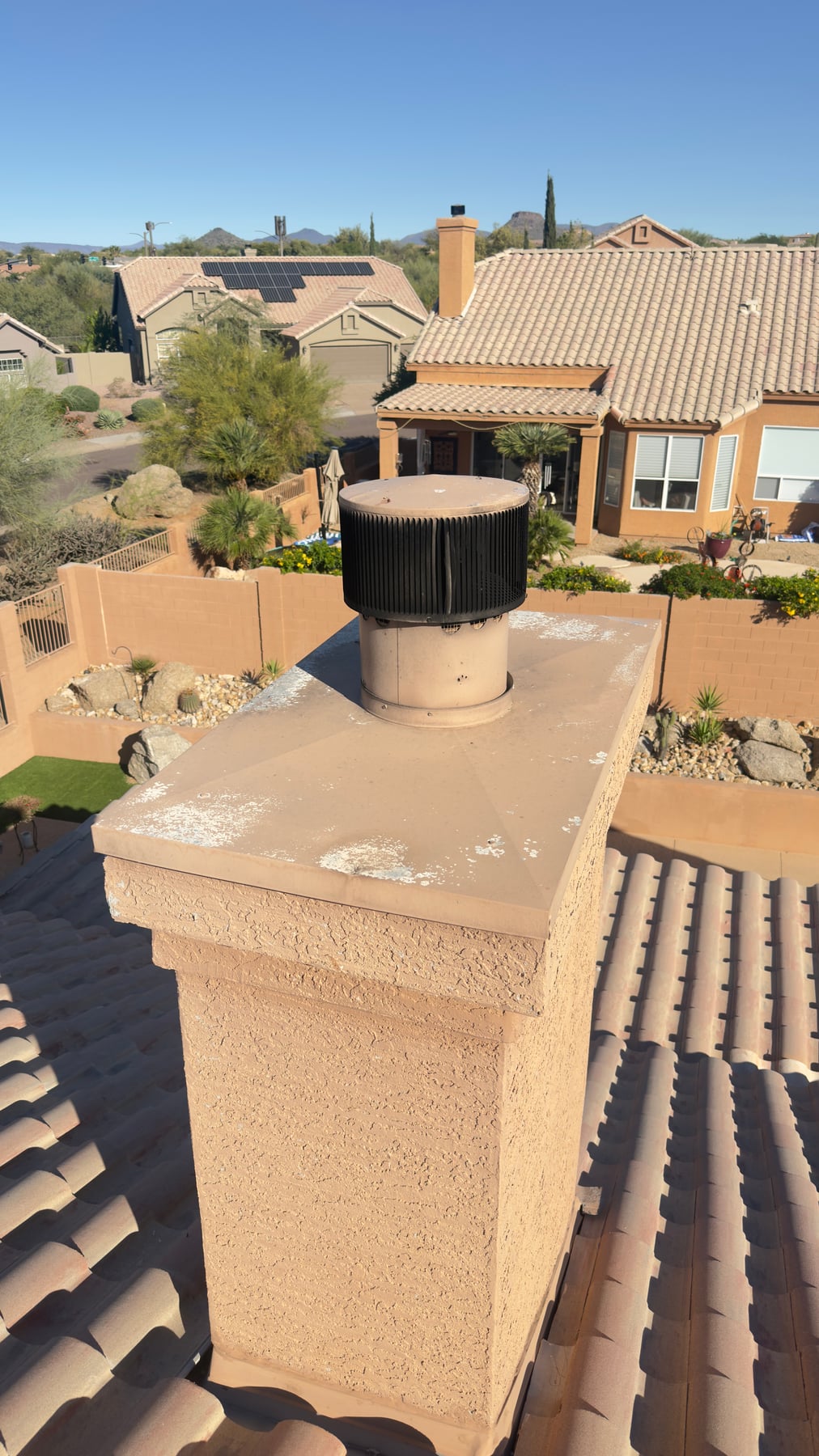
When a chimney cap ends up missing or broken after a storm, there are a few different things that could have gone wrong — sometimes it's the storm alone, but more often the cap had a pre-existing weakness that the wind finally exploited. Here are the most common reasons we find when we get up on the roof:
- Undersized or lightweight aluminum cap: Many older Phoenix homes were built with thin aluminum caps that simply weren't rated for monsoon-level wind loads. They bend, crack, and eventually separate from the flue entirely — sometimes taking years, sometimes one bad storm.
- Failed mortar or sealant bond: The cap attaches to the flue tile with mortar, masonry screws, or sealant. Phoenix's extreme heat — we're talking rooftop temperatures above 150°F in summer — degrades these bonds over time. Once the connection fails, the cap is only held on by gravity.
- No mechanical anchoring: Some caps are just set in place rather than screwed or strapped down. On a calm day, that's fine. In a microburst, it's a problem. We see a lot of these on chimneys that had a cheap cap installed years ago by a general roofer rather than a chimney specialist.
- Cracked or crumbling chimney crown: The crown is the concrete or mortar cap that seals the top of the chimney around the flue tile. If the crown is cracked, the entire top of the chimney shifts slightly under wind load, and that movement works the cap loose even if it was originally well-secured.
- Storm impact from debris: Monsoon winds carry tree branches, gravel, and other debris. A direct hit from something solid can crack or dislodge even a well-installed cap without any prior weakness.
- Rust and corrosion on the cap band: Galvanized caps corrode over time, and once the band that clamps to the flue tile rusts through, the cap has nothing holding it. This one tends to happen gradually and often goes unnoticed until the cap is already loose.
Without getting eyes on the flue from the top, it's hard to know which of these is your situation. When we inspect, we assess not just the cap itself but the crown condition, the flue tile, and the anchoring point — because replacing the cap without addressing an underlying issue just means you'll be calling us again next monsoon season.
Why This Is Dangerous
A missing chimney cap is genuinely something you shouldn't leave open-ended, but it's also not a drop-everything emergency in the way a gas leak or active fire would be. Here's how to think about timing:
It's okay to wait a day or two if:
- The fireplace is not in use and you don't plan to use it anytime soon — your main concern is weather and wildlife intrusion, both of which are serious but not immediately dangerous
- The cap is broken but still partially covering the flue — partial coverage isn't ideal, but it reduces the urgency slightly compared to a fully open flue
- You've placed a temporary cover over the chimney top (a piece of hardware cloth secured with weights) to block birds and debris while you schedule service
Call us now if any of these apply:
- You've already heard birds, scratching, or flapping sounds inside the chimney — nesting can happen within 24-48 hours of the cap coming off, and once a nest is established it creates additional problems
- It rained significantly after the cap came off — water in an open flue can damage the firebox, the damper, and the interior masonry, and the sooner we assess it the better
- You can see daylight directly through the top of the firebox when you look up — that means the flue is completely exposed
- You attempted to use the fireplace after the cap was lost and noticed unusual smoke behavior, odors, or debris falling into the firebox
Safety Checklist Before You Call
Before we arrive, there are a few things you can safely check yourself — nothing that requires getting on the roof or handling anything structural, just a quick assessment that helps us help you faster:
- Look up into the firebox from inside: Open the damper and look up with a flashlight. If you can see light at the top, the flue is open. Also look for debris, leaves, or any sign that birds have already made their way in. Tell us what you see when you call — it helps us bring the right materials.
- Check the roof from the ground with binoculars: You don't need to climb anything. A good look from the driveway or backyard will often tell you whether the cap is fully gone, cracked, or just shifted. Note which direction it seems to have moved — that's useful information for us.
- Check for debris in the firebox: Open the fireplace doors or screen and look into the firebox itself. Leaves, small branches, or animal material in there means something has already come down the flue. Don't use the fireplace if you see any of this.
- Keep the damper closed: If your damper is functional, keep it closed until we arrive. It won't fully seal the flue, but it will reduce airflow and make it harder for birds or large debris to reach the firebox.
- Do not attempt to climb on the roof: We mean this one seriously. Phoenix rooftops are extremely hot for much of the year, steep tile roofs are slippery, and chimney repair requires proper anchoring equipment. Leave the roof assessment to us.
If you've done all of this and you're ready to schedule — or if you already hear animals in there — call us now. We have techs in Phoenix every day and can typically get out the same day for cap replacements.
Professional Chimney Services in Phoenix
Phoenix's monsoon season runs from mid-June through September, and the microbursts that roll through the Valley are genuinely unlike what most people picture when they hear the word "storm." Wind gusts in a microburst can exceed 80 mph in localized areas, and they hit with almost no warning. A cap that was perfectly fine in June can be airborne by July.
What makes it worse is that many Phoenix chimneys were originally built with lightweight aluminum or galvanized caps that weren't designed for that kind of lateral force. Over the years, the mortar or sealant holding the cap to the flue tile dries out in our heat — and once that bond is gone, the cap is essentially just sitting there waiting for the right gust.
We also saw a significant uptick in storm-related chimney calls after the 2024 monsoon season. That particular stretch of weather was rough on a lot of components — caps, flashing, crowns — because we had driving rain paired with the usual intense heat cycling, which accelerates the breakdown of older sealants and mortar. If your cap survived 2024, it may still be compromised in ways that aren't visible from the ground.
Bottom line: this is a Phoenix-specific problem that requires a Phoenix-specific fix. We anchor caps differently here than a contractor in a mild climate would, and that difference matters come July.
What It Costs to Fix
Chimney cap replacement in Phoenix typically runs between $150 and $450, depending on the size of your flue, the cap style required, and whether any additional work is needed at the crown or flue tile. Here's a breakdown of what the most common scenarios look like:
| Service | Typical Price Range |
|---|---|
| Standard single-flue stainless steel cap — supply and install | $150 – $275 |
| Oversized or custom-fit cap for non-standard flue dimensions | $225 – $375 |
| Cap replacement plus minor crown patching (hairline cracks, surface repair) | $300 – $450 |
| Cap replacement plus debris/nesting material removal from flue | $250 – $400 |
A few things that can push the price toward the higher end: a very large or multi-flue chimney, significant crown damage that needs more than surface patching, after-hours emergency calls, or a flue tile edge that's badly deteriorated and needs prep work before the cap can be anchored securely. We'll always give you a written estimate before we start any work — no surprises on the final invoice. Our standard diagnostic and inspection fee is $99, which is credited toward the repair cost if you proceed with us.
Arizona Chimney Pros
Arizona Chimney Pros has been working on Phoenix-area chimneys through monsoon seasons, triple-digit summers, and everything in between. We understand the specific ways that our climate beats up chimney components — the heat cycling that dries out sealants, the microbursts that test every anchor point, the dust that works into every gap during the dry months. That's not something you learn from a textbook; it comes from being on Phoenix rooftops year after year.
We are ROC-licensed and fully insured in Arizona. Every technician who goes on your roof carries liability coverage, and we work within Arizona code requirements for chimney components and installation. When we anchor a cap, we do it in a way that meets the load requirements for this region — not the minimum spec for a mild-weather market.
We see storm-related cap damage several times a month during monsoon season, and honestly a fair number of times during the spring wind events too. This specific repair is something our techs do constantly, which means we stock the right caps, we carry the right anchoring hardware, and we don't have to order anything special for a standard Phoenix chimney. Most cap replacements are completed in a single visit, usually within a few hours of arrival.
Response time matters after a storm. We prioritize same-day service in Phoenix, Scottsdale, Tempe, and Mesa for cap-related calls.
Brands We Service
We service most major fireplace and chimney brands across Phoenix — OEM parts stocked for the most common issues, and we can source almost anything we don't have on the truck. Below are the brands we see most often:
- Napoleon
- Regency
- Valor
- Majestic
- Heat & Glo
- Heatilator
- Mendota
- Lopi
- Pacific Energy
- Dimplex
- Jotul
- Vermont Castings
Frequently Asked Questions
We'd recommend against it, at least until we can inspect the flue. Once a cap is gone, debris and rainwater can enter the flue, and if anything landed on the damper or in the firebox itself, you'd essentially be lighting a fire under or near that material. If there's been any rainfall since the cap came off, there may also be moisture in the flue that needs to dry out before use. It's not that using the fireplace once is guaranteed to cause a problem — it's that you don't know what came down that open flue, and finding out by lighting a fire isn't the right way to check. Give us a call and we'll get out there quickly.
Phoenix monsoon microbursts are a major factor — the wind speeds involved can rip a cap right off if the anchoring was marginal to begin with. But in most cases the storm didn't cause the failure on its own; it exposed a weakness that already existed. The most common culprits are a dried-out mortar bond, a corroded cap band, an undersized aluminum cap that wasn't designed for high wind loads, or no mechanical anchoring at all. Our desert heat is brutal on the sealants and mortar that hold caps in place — after several years, those materials deteriorate significantly. The combination of degraded anchoring plus one serious gust is usually what we find when we get up there.
For most single-flue Phoenix chimneys, you're looking at somewhere between $150 and $275 for a standard stainless steel cap, installed with proper anchoring. If your flue is oversized, if we need to remove nesting material or debris first, or if the chimney crown needs patching before we can anchor the new cap correctly, the total will be higher — typically $300 to $450 for those combined repairs. We charge a $99 inspection fee to get up on the roof and assess everything properly, and that fee is applied toward the repair if you move forward with us. We'll give you a written estimate before any work starts.
We prioritize cap replacement calls in Phoenix, Scottsdale, Tempe, and Mesa — same-day service is our standard for this type of repair during and after monsoon season. We keep stainless caps in multiple standard sizes in stock specifically because this is a high-frequency repair for us in the Valley. If you call in the morning, there's a strong chance we can have a technician out the same afternoon. The longer the flue stays open, the higher the risk of birds nesting or rain damage accumulating, so we don't want you waiting any longer than necessary either.
A cracked or shattered cap usually means it took a direct impact from wind-driven debris — gravel, a branch, or something else the microburst picked up. It can also mean the cap material itself had become brittle over time from UV exposure and heat cycling, and the storm stress was just enough to crack it. In terms of repair, a broken cap is handled the same way as a missing one — we remove whatever fragments are left, inspect the flue tile and crown beneath it, and install a new stainless steel cap with proper mechanical anchoring. The only difference is we may need to do a little more cleanup if broken cap pieces fell into the flue.
It depends on your policy, but storm damage to chimney caps is often covered under the wind and hail portion of a standard homeowner's policy — especially if a monsoon microburst was the documented cause. The key is documenting the damage properly. We take photos during every inspection, and we can provide a written scope of damage and repair estimate that you can submit to your adjuster. The $99 inspection fee is typically a reimbursable expense under most claims. We'd recommend calling your insurance provider to ask specifically about chimney component damage under your wind coverage before assuming it's out of pocket.
What Our Customers Say
We had them do a Level 2 inspection after buying our house. They found issues the previous inspector missed — loose damper, cracked tiles in the flue. Saved us from a bad surprise down the road.
Gas fireplace wouldn't light on the first cold night in November. They had a tech out the same afternoon, diagnosed a bad thermocouple in fifteen minutes, had the part on the truck, done in under an hour. Fair price, no upsell.
Had a chimney cap fly off in a monsoon. Called Monday morning, they had it replaced by Tuesday afternoon with a stainless-steel cap that won't rust out. Solid work at a fair price.
Serving Phoenix & Surrounding Areas
Arizona Chimney Pros serves Phoenix and surrounding Phoenix metro communities. Our technicians are on the road daily with same-day and next-day availability across:
- Scottsdale
- Tempe
- Mesa
- Gilbert
- Chandler
- Glendale
- Peoria
Don't see your neighborhood? Call us — our service radius covers about 40 miles of the Valley.
More Services in Phoenix
- Chimney Repair Phoenix
- Chimney Inspection Phoenix
- Chimney Cap Installation Phoenix
- Chimney Animal Removal Phoenix
- Creosote Smell In House Phoenix
- Gas Fireplace Turns Off After Minutes Phoenix
- Pilot Light Keeps Going Out Phoenix
- Gas Fireplace Repair Phoenix
- Chimney Leak Repair Scottsdale
- Pilot Light Wont Stay On Scottsdale
- Chimney Inspection Cost Phoenix
- Smoke Backing Into House Phoenix
Cap Gone? Let's Get Your Chimney Sealed Today.
We have technicians across Phoenix, Scottsdale, Tempe, and Mesa every day — same-day cap replacement is standard for us, not an exception. Give us a call and we'll get someone out quickly, get up on the roof, and tell you exactly what happened and what it costs to fix it before we touch anything. No pressure, no surprises. Just a straight answer and a proper repair from people who do this in Phoenix every week.
Sun–Fri 8am–7pm · Emergency service available
Explore More Topics
Helpful guides and related services for Phoenix-area homeowners.