
Gas Fireplace Smells Like Gas? What It Means — and What to Do Right Now
A faint gas smell near the fireplace is the one symptom you don’t guess at. Here’s how to tell a real leak from a harmless first-burn smell, the exact steps to take in the moment, and what the fix usually turns out to be in a Phoenix home.
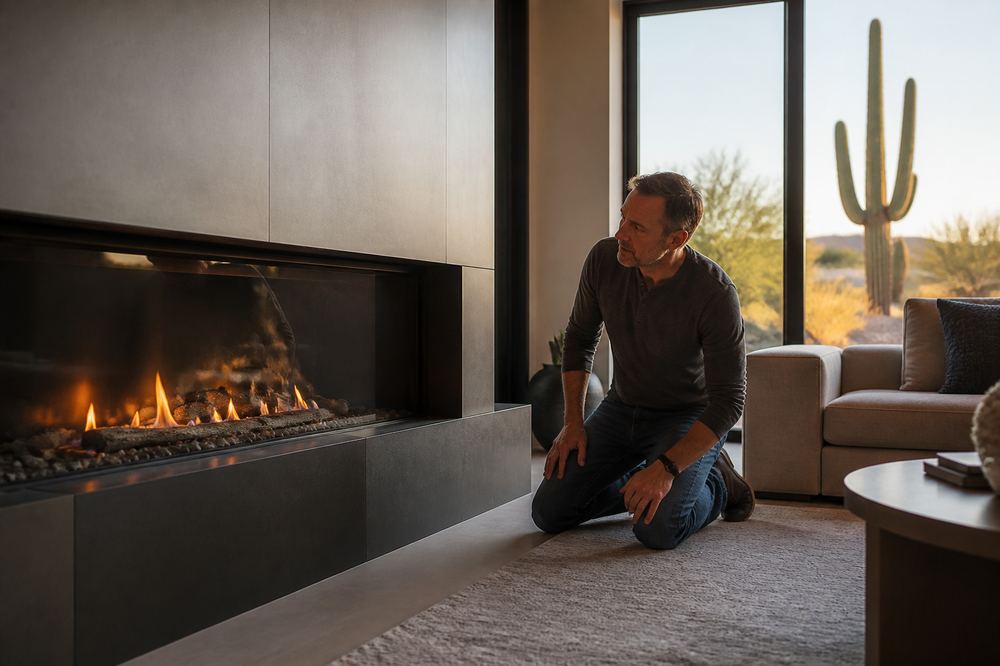
A Mesa homeowner had been ‘smelling gas’ for three weeks but was afraid to call. It was a minor pilot tube leak — tightening the fitting solved it in ten minutes, and we sleep better knowing it’s done. That call is the whole reason we wrote this: the smell is worth taking seriously, and the fix is usually far smaller than the worry.
First — is it actually gas, or the first-burn smell?
Two very different things get reported as “my fireplace smells like gas,” and telling them apart matters.
Natural gas is odorless on its own, so utilities add mercaptan — the sharp, sulfur, rotten-egg odor you associate with a gas leak. If that’s what you smell, treat it as a real leak and act. It tends to be strongest right at the firebox or along the gas line, and it doesn’t fade on its own.
The harmless version is different. The first time you run a gas fireplace after a long Arizona summer, dust and residue that settled on the burner all season burn off — a warm, dusty, slightly acrid smell that fills the room for fifteen or twenty minutes and then clears. Mesa homeowners calling about “fireplace smells” in October are almost always experiencing exactly that first burn of the season. If the smell is dusty rather than sulfur, fades as the unit runs, and only happens on that first fire, it’s usually nothing.
The rule we give people: if it smells like rotten eggs, or it lingers, or it shows up when the fireplace is off, stop and treat it as a real leak.
What to do the moment you smell gas
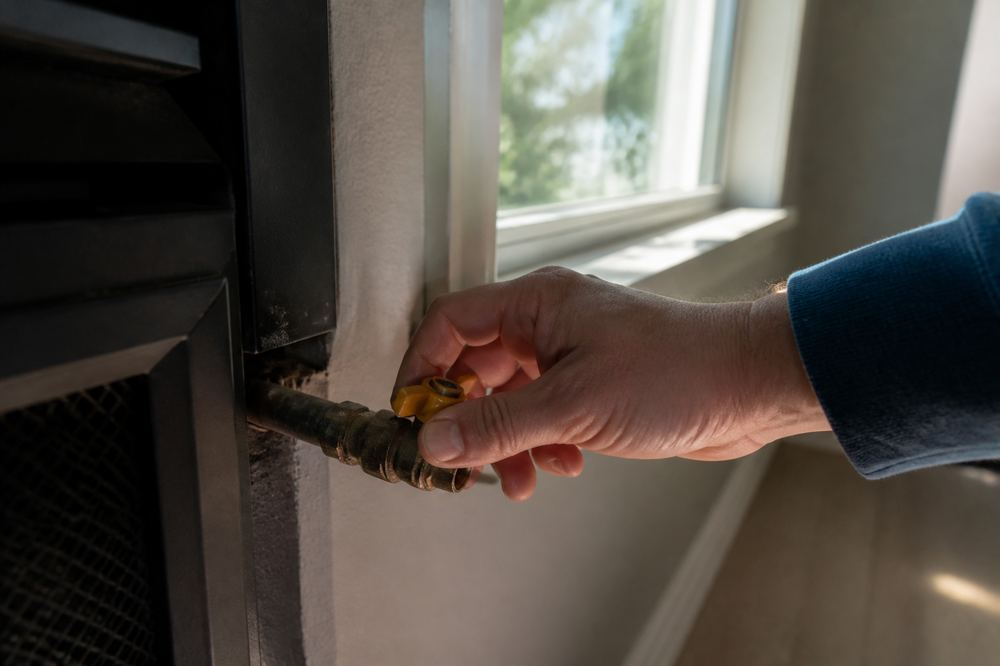
If you believe it’s a real gas smell, handle it in this order and don’t overthink it:
- Shut off the gas at the fireplace. There’s usually a quarter-turn valve on the supply line right next to the unit. Turn it so the handle sits crosswise to the pipe.
- Open windows and doors. Get fresh air moving through the room.
- Don’t touch switches or flames. No light switches, no lighters, no fireplace remote — a spark is the one thing you’re avoiding.
- Leave the area. If the smell is strong, step outside and make the call from there.
- Call a licensed gas technician. A faint smell after a long off-season can be residual, but a persistent smell is a leak until a tech proves otherwise.
If the odor is overwhelming or you feel lightheaded, leave the house and call your gas utility’s emergency line before anyone else. That’s the one case where you don’t wait on a service appointment.
What a real gas smell usually turns out to be
Here’s the part that calms most people down: a confirmed gas smell at the fireplace is almost never the dramatic scenario. It’s usually a small, fixable connection problem.
- A loose or worn pilot-tube fitting. The thin line feeding the pilot can loosen over years of heat cycling. It weeps a little gas — enough to smell, small enough to tighten or reseat in minutes.
- A connection at the control valve. Flare fittings and flex-line connections can back off slightly. A tech checks each one with a leak detector and snugs or reseals it.
- A tired gas valve. On older units, the valve itself can seep. This is the larger of the common fixes, but it’s still a defined repair, not a teardown.
- A dormant unit that sat too long. In Paradise Valley estates we often find a dining-room gas unit from the 90s that nobody uses; by the time someone notices a smell, the valve has been idle for years and wants a full service.
None of these are things to live with for three weeks. They’re things to confirm and close out the same week.
How we actually find the leak
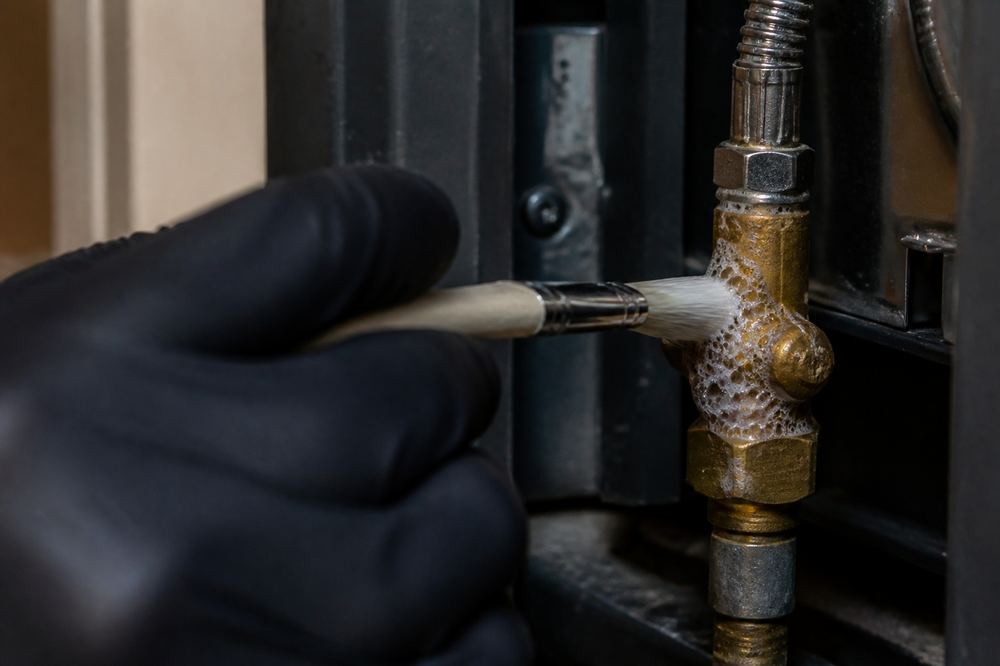
We don’t guess at a gas smell — we test for it. The first pass is the classic one: a soapy solution brushed onto every fitting along the line. Where gas escapes, the solution bubbles, and the bubble shows us the exact joint. It’s simple, and it’s reliable.
From there we confirm with a calibrated electronic leak detector at the valve, the pilot assembly, and each flex-line connection, and we check gas pressure with a manometer. The goal is a specific failure point, not a vague “might be the valve.” Once we find it, we tell you exactly what it is and what it costs before we touch anything.
Why the flame color is part of the story
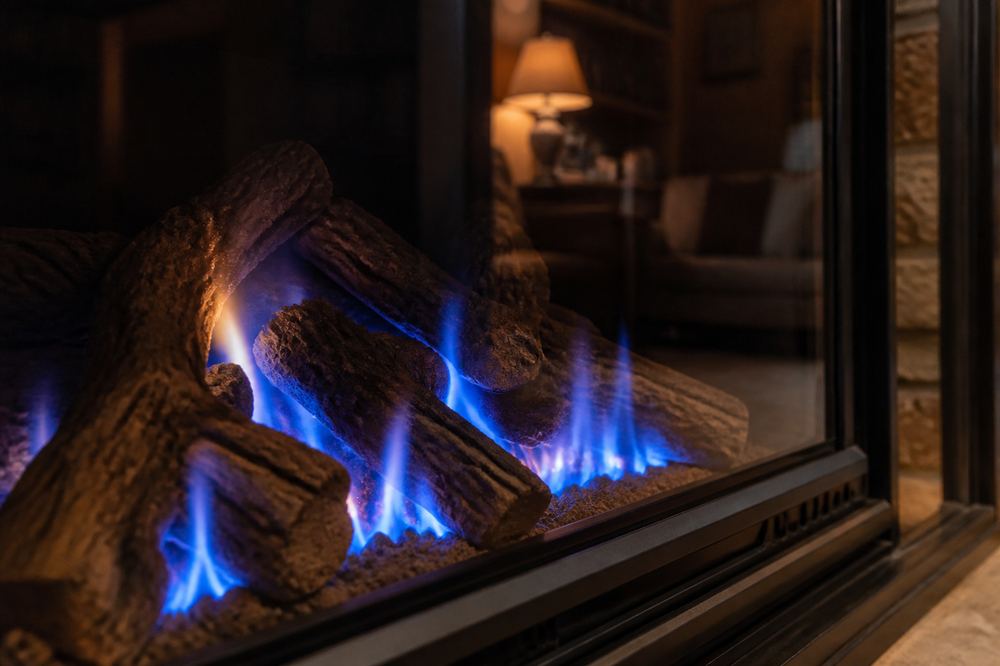
While we’re there for a smell, we look at how the unit burns. A clean blue flame across the burner means complete combustion — the fuel is burning the way it should. That’s the picture above, and it’s what you want.
A flame that burns lazy and yellow is a different flag. In older Tempe condos near ASU we run into gas fireplaces that haven’t been serviced in a decade — dust packs into the burner tray and the flame burns yellow instead of blue. Yellow flames mean incomplete combustion, which produces more carbon monoxide and leaves soot on the glass. It’s usually a cleaning-and-tune fix, not a scary one, but it’s worth catching. If you don’t already have a carbon monoxide detector near the fireplace, add one — it’s cheap insurance for any home with a gas appliance.
Why Phoenix gas fireplaces do this
Valley fireplaces sit unused from April through September, sometimes longer. That long dormancy is where most of these issues actually begin — not during use.
Desert dust works its way into burner assemblies and pilot orifices during the off-season, and monsoon storms push fine particulate into any gap they can find. Fittings that were snug in spring loosen a hair over months of 110-degree afternoons followed by cool nights, and seals dry out. Then October arrives, you light the unit for the first time in six months, and a small problem that was quietly developing all summer announces itself — sometimes as a click, sometimes as a weak flame, sometimes as a smell.
That’s why annual service matters here even on a fireplace you barely run. A yearly tune-up keeps the pilot assembly clean, the connections checked, and the valve verified, so the first cold night isn’t when you discover something’s wrong.
What it costs to fix in the Valley
The numbers below come straight from our service pricing — we don’t invent them, and we quote in writing before any work starts.
- Diagnostic visit — typically $99, and it applies toward the repair if you move forward with us that visit.
- Most gas fireplace repairs — $150 to $450. Tightening or reseating a fitting and replacing wear parts like a thermocouple sit on the low end; control-board or valve work sits higher.
- Annual tune-up — the preventive option, covering a full safety and combustion check so small issues are caught before they become a smell.
If a smell turns out to be a loose fitting, you’re usually at the low end of that range. For the bigger picture on whether an older unit is worth repairing, see our guide on repair vs. replace for a gas fireplace in Arizona.
How we’d handle it — and how to book
We test first, find the exact joint, and quote before we work. Gas-smell calls move to the front of our schedule because they should — safety first, every time. Most weeks we can be at a Valley home the same day for a suspected gas issue.
Direct line: (602) 557-5071. Related help: gas smell from a fireplace in Mesa, pilot light won’t stay lit, and fireplace won’t light.
Jump to your city: Phoenix · Scottsdale · Mesa · Tempe · Chandler · Gilbert · Glendale.
Frequently Asked Questions
What should I do if I smell gas near my fireplace?
Treat it as urgent. Turn off the gas supply valve at the fireplace if you can access it, open windows, leave the area, and avoid any ignition source. Don’t turn switches on or off. Call a gas technician immediately — we respond same-day for gas smell calls.
Why won’t my gas fireplace light?
The most common causes are a dirty or drifted pilot assembly, a failed thermocouple or thermopile, a weak igniter, or a gas supply issue. In Arizona, dust infiltration through the off-season is the number one cause we see when fireplaces fail to light in October and November.
Why does my pilot light keep going out?
A pilot that lights but won’t stay lit is almost always a failing thermocouple or thermopile — the sensor that tells the gas valve the pilot is present. It’s a common wear item, typically an inexpensive part and under an hour of labor to replace.
Why is my fireplace making a clicking noise?
Clicking during ignition is the igniter trying to spark the pilot or burner — a normal sound. Clicking when the fireplace is off usually means the electronic control is stuck trying to ignite, often caused by a dirty pilot tube or a failed ignition board.
How often should a gas fireplace be serviced in Arizona?
Annual service is the standard recommendation — one tune-up per year keeps the pilot assembly clean, the igniter components tested, and the gas valve verified. In Arizona the dust accumulation from dry summers and monsoon-driven fine particulates makes this especially important, even if the fireplace is barely used during the year.
What’s included in a gas fireplace tune-up?
A complete tune-up includes a visual inspection of the firebox and venting, cleaning of the pilot assembly and burner tray, testing of the thermopile and thermocouple, verification of gas pressure, combustion check, remote or switch operation test, and a safety check for any leaks at fittings.
How much does gas fireplace repair cost?
Most repairs fall in the $150 to $450 range. Simple fixes like thermocouples or igniters are on the lower end; control board replacements or valve work are higher. A diagnostic visit typically runs $99 and applies toward the repair if you proceed.
Can you come out same day?
Yes — we reserve capacity for same-day and emergency calls, especially for gas smell or safety concerns. Call us early in the day and we’ll get you slotted; most Phoenix-area calls we can reach within a few hours.