
Why Your Gas Fireplace Won’t Turn On — and What to Try Before You Call
Five reasons a gas fireplace stops lighting — and the order we check them on a Valley service call, so you don’t pay for diagnostic time you don’t need.
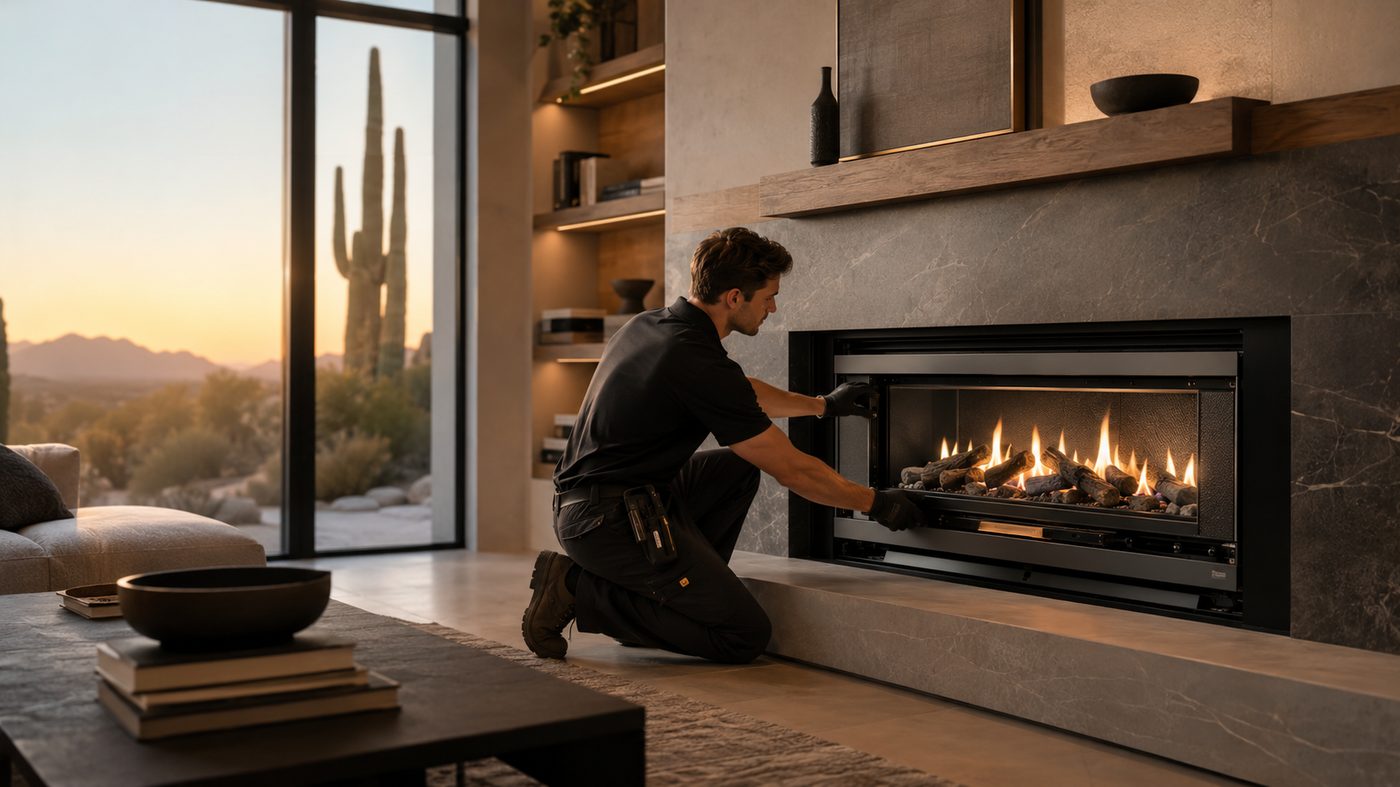
The first cold snap last November we got eight calls in a single morning from homeowners in Phoenix and Scottsdale whose gas fireplaces had been sitting unused since March and refused to light. Not one of them needed a major repair. Seven of the eight needed the pilot assembly cleaned of dust the dry summer had packed into it. The eighth needed a $40 thermocouple. That’s the pattern every fall here.
First: the 60-second safety check
Before any troubleshooting, three checks. Skip none.
- Smell test. If you smell gas — sulfur, rotten egg, anything chemical — stop. Turn off the gas shutoff valve at the fireplace if you can reach it safely. Open windows. Leave the area. Don’t flip light switches on or off. Call us at (602) 557-5071 or call your gas utility. We respond same-day for gas-smell calls.
- Switch / remote check. Confirm the wall switch is on, the remote has fresh batteries, and the unit is plugged in if it has an electronic control board. About one call in ten is solved here.
- Gas valve at the unit. Some homeowners turn it off in spring and forget. The handle parallel to the line means open; perpendicular means closed.
If you cleared those three, you’re ready to diagnose what’s actually wrong.
The pilot lights, but won’t stay lit (thermocouple or thermopile)
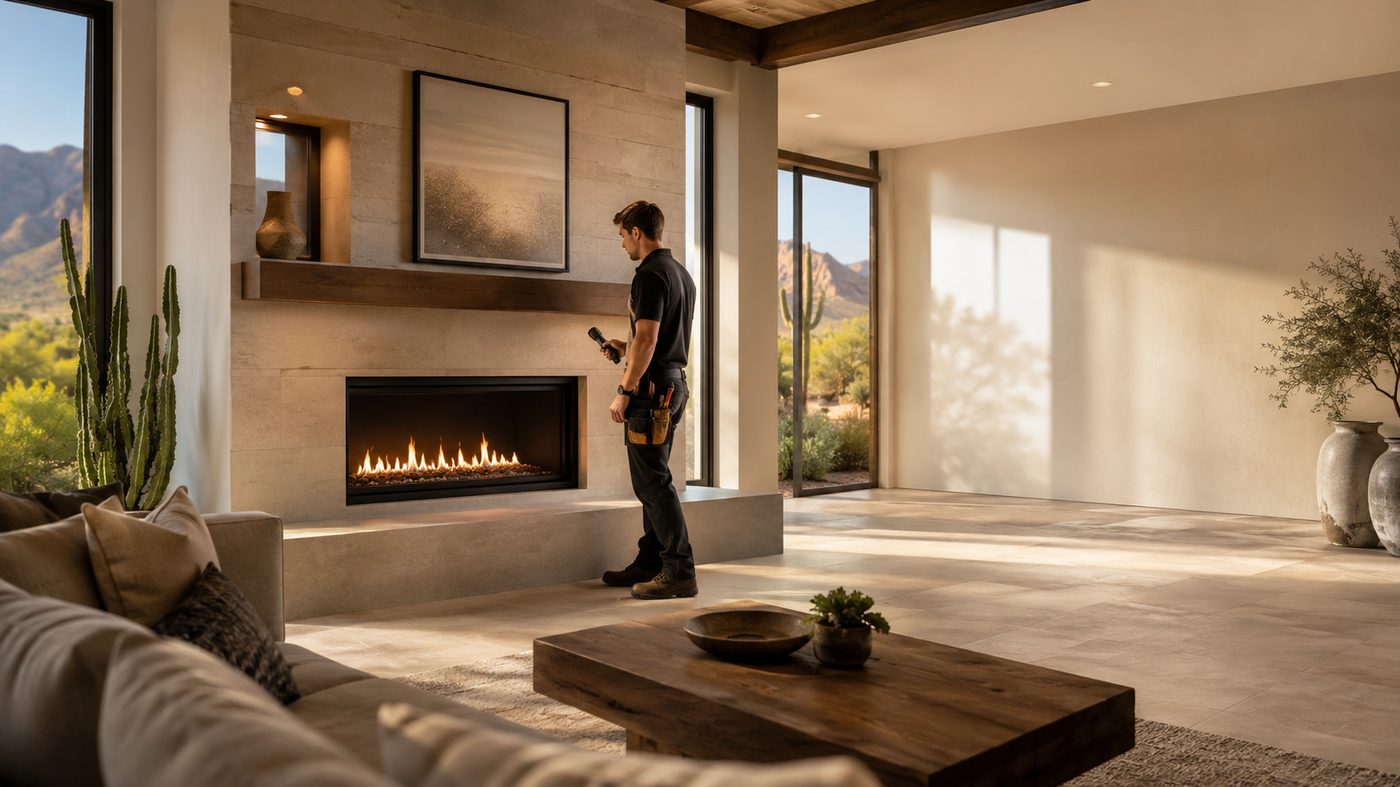
You hold the pilot button for thirty seconds, it lights, you release — and it goes out. This is the most common failure pattern we see on gas fireplaces older than about eight years, and it’s almost always the thermocouple or thermopile: the small probe sitting in the pilot flame whose job is to tell the gas valve, “the pilot is lit, keep gas flowing.”
When it ages out, the signal drops below the threshold and the valve closes for safety. That’s the system working as designed. The part is inexpensive, the labor is under an hour, and it’s exactly the kind of repair where a same-day technician saves you a cold weekend.
In North Scottsdale and DC Ranch homes built in the late 90s we commonly see direct-vent gas units where the original thermopile has drifted below spec — the pilot stays lit but the main burner clicks and dies. Five-dollar part, forty-minute fix. Mesa gas inserts from the late 80s and early 90s almost always have an original Honeywell millivolt system that just gives up after twenty years of cycling.
It clicks but won’t ignite (dirty pilot or weak igniter)
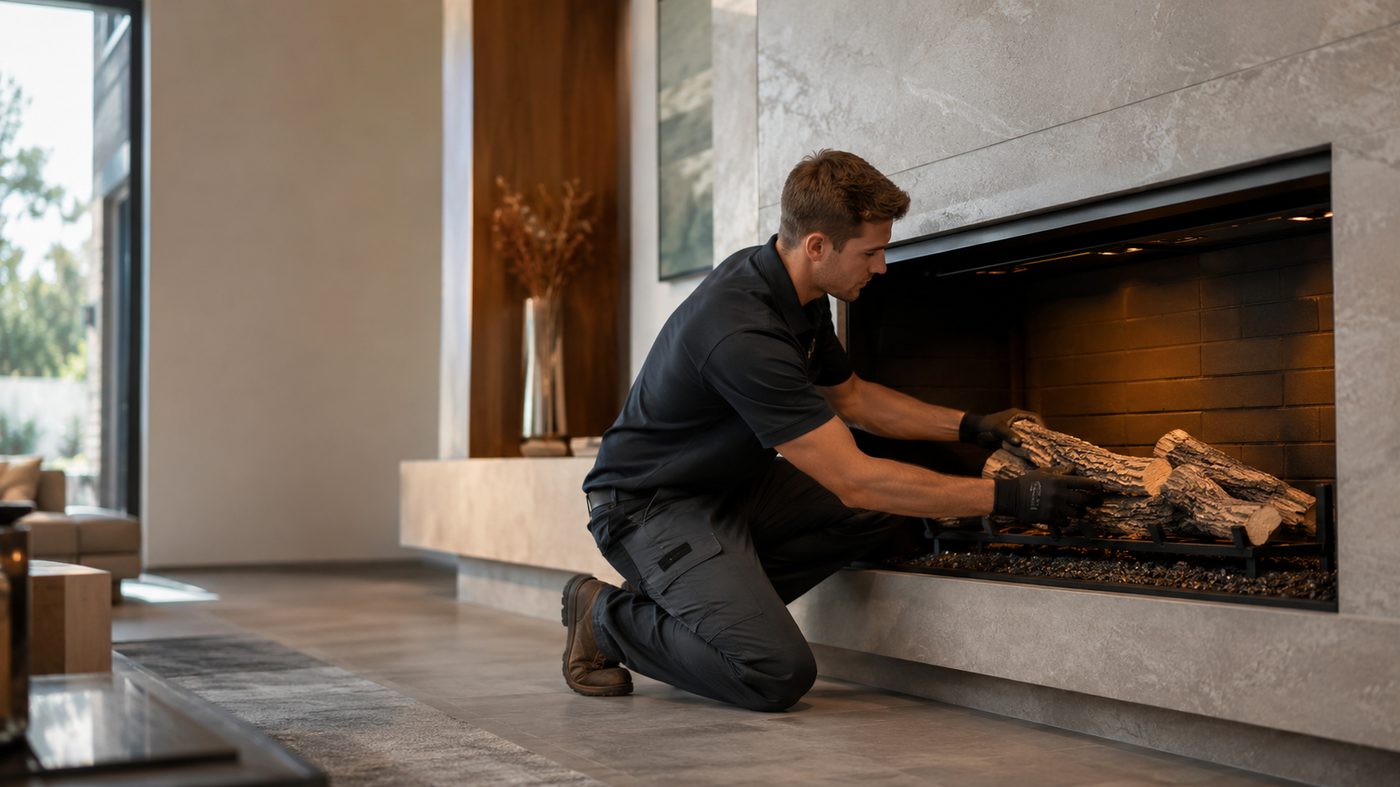
You hear the clicker tick, but no flame appears. Two suspects.
Dust in the pilot orifice. Arizona’s dry summers pack fine particulate into anything sitting unused for six months. The pilot orifice is a needle-fine hole; even a small dust film blocks the gas-air mix enough that the spark has nothing to catch. A trained tech pulls the pilot, cleans it with compressed air and a soft brush, and reseats it. Don’t use canned air with propellant on a gas appliance.
Corroded igniter electrode. In Gilbert and Chandler tract homes from the 2000s, the gas log sets are usually original to the build. We see igniter electrodes corroded from humidity during monsoon season — a $40 part that fixes “fireplace won’t light.” You can sometimes see green or white residue on the electrode tip from below.
For a Phoenix-specific writeup of this exact failure, see Gas Fireplace Won’t Light in Phoenix. For the “won’t stay on” variant, see Pilot Light Won’t Stay On in Scottsdale.
The remote or switch does nothing (control board, batteries, low millivolt)
The pilot is lit, the unit looks healthy — but flipping the wall switch or pressing the remote does nothing. Three things to check, in order.
- Receiver batteries. Many gas fireplaces have a small battery pack tucked behind a louver next to the control box, not just in the handheld remote. They feed the on-off solenoid. When they die the fireplace can’t take the “on” signal.
- Wall switch wiring. A single broken millivolt wire on a switch that’s been there twenty years happens more than you’d think. We test by bridging the terminals at the valve directly — if it fires, the fault is upstream.
- Control board. Scottsdale luxury linear fireplaces — the wide modern ones — usually run a proprietary electronic ignition board. When those boards fail the repair isn’t the cheapest, but we keep the three most common boards on the truck.
A gas-supply problem upstream of the unit
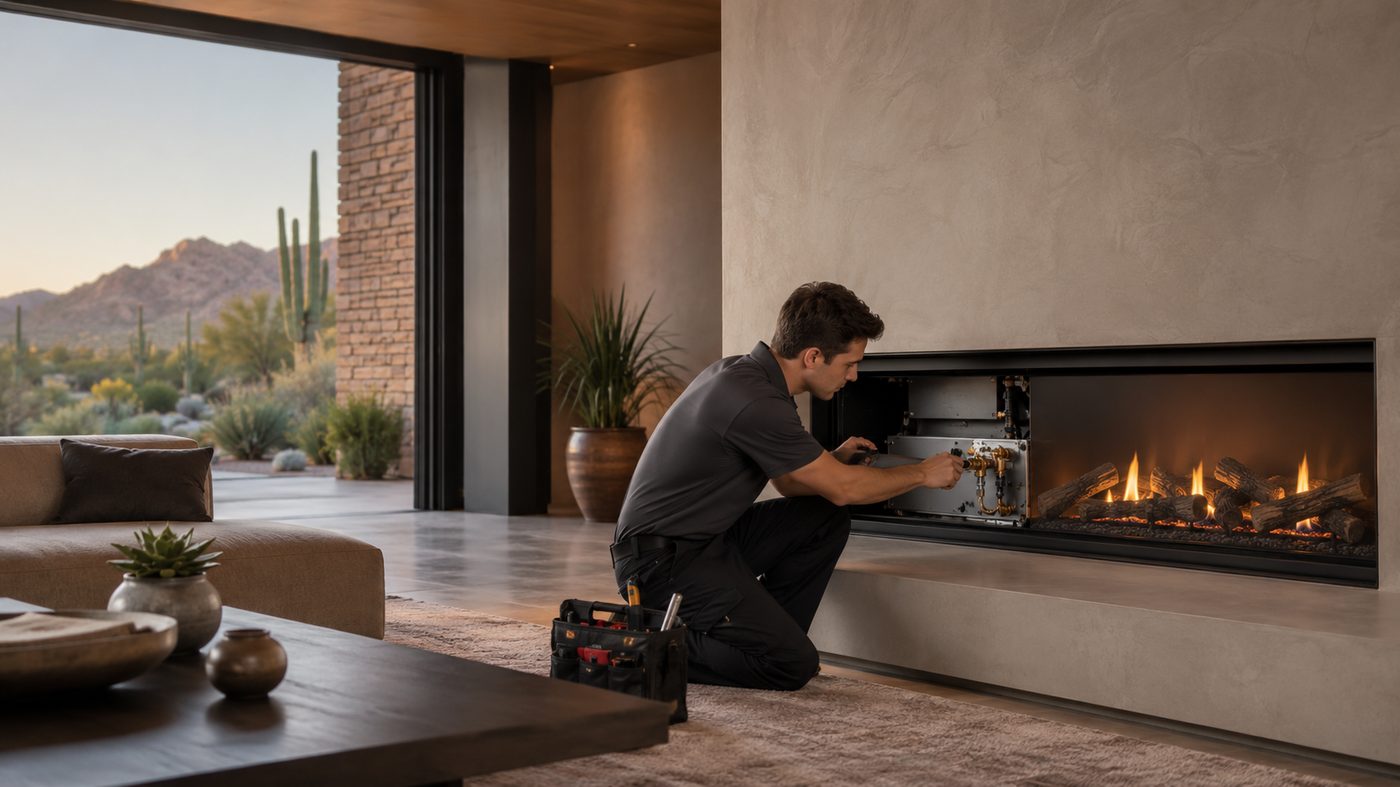
Three classes of upstream issue, in roughly the order we test them.
Gas shutoff partially closed. Looks open from one angle, isn’t. We’ve seen this twice in the last month.
Regulator stuck. The pressure regulator at the meter or the secondary at the unit can stick after a long off-season. The fix isn’t homeowner work; we test pressure with a manometer at the valve.
Low pressure pockets. In certain pockets of the Valley — particularly older Tempe condos near ASU and some Mesa neighborhoods on long branch lines — gas pressure runs lean during peak winter demand. The fireplace lights fine in March, doesn’t in December, and the homeowner thinks the unit failed. It didn’t. The line did.
A safety pressure switch tripped (vent obstruction)
Direct-vent and B-vent units have a pressure switch that confirms the vent is clear before the burner will fire. A blocked termination cap — a bird nest, a tile-roof debris jam, or even desert dust — trips that switch and the unit refuses to light.
This is the case where we strongly prefer the homeowner stop troubleshooting and call. Bypassing a safety switch on a vented gas appliance is a carbon-monoxide risk. We get on the roof, inspect the termination, clear it, and verify the switch operates correctly.
The reason this fails every October in the Valley
Six months of disuse plus six months of fine desert dust equals one cold morning when nothing works. Roughly seven out of eight first-of-the-season calls we run trace back to one of two things: a dirty pilot or a tired thermocouple. Both are inexpensive. Both are exactly what an annual tune-up catches before they leave you cold.
That’s the trade. Roughly $99 to $189 in October for the inspection and clean, against $150 to $450 in a panic in December — sometimes more, if it’s a board or a vent issue.
What this typically costs in the Valley
The numbers below come from our own service-page anchors and FAQ bank. We do not invent them.
- Most gas fireplace repairs — $150 to $450. Thermocouples and igniters anchor the low end; control boards and valve work anchor the high end.
- Diagnostic visit — about $99, applied toward the repair if you proceed.
- Annual tune-up — pilot clean, thermopile test, gas-pressure check, combustion check, safety check.
For the wider context on when a repair is worth it versus walking away from the unit, see repair vs. replace your gas fireplace and honest costs: gas vs wood fireplace repair in Arizona.
When to stop troubleshooting and call
Stop and call if any of the following is true.
- You smell gas, even faintly.
- The unit lights but the flame is yellow, sooty, or behaves differently than it used to.
- You suspect a vent obstruction or the pressure switch is involved.
- The fix involves the gas valve, the control board, or any sealed-combustion component.
- You’ve cycled the pilot more than three times without success.
Direct line: (602) 557-5071. Jump to your city: Phoenix · Scottsdale · Mesa · Chandler · Gilbert · Paradise Valley.
Frequently Asked Questions
Why won’t my gas fireplace light?
The most common causes are a dirty or drifted pilot assembly, a failed thermocouple or thermopile, a weak igniter, or a gas supply issue. In Arizona, dust infiltration through the off-season is the number one cause we see when fireplaces fail to light in October and November.
Why does my pilot light keep going out?
A pilot that lights but won’t stay lit is almost always a failing thermocouple or thermopile — the sensor that tells the gas valve the pilot is present. It’s a common wear item, typically an inexpensive part and under an hour of labor to replace.
Why is my fireplace making a clicking noise?
Clicking during ignition is the igniter trying to spark the pilot or burner — a normal sound. Clicking when the fireplace is off usually means the electronic control is stuck trying to ignite, often caused by a dirty pilot tube or a failed ignition board.
What should I do if I smell gas near my fireplace?
Treat it as urgent. Turn off the gas supply valve at the fireplace if you can access it, open windows, leave the area, and avoid any ignition source. Don’t turn switches on or off. Call a gas technician immediately — we respond same-day for gas smell calls.
How much does gas fireplace repair cost?
Most repairs fall in the $150 to $450 range. Simple fixes like thermocouples or igniters are on the lower end; control board replacements or valve work are higher. A diagnostic visit typically runs $99 and applies toward the repair if you proceed.
How often should a gas fireplace be serviced in Arizona?
Annual service is the standard recommendation — one tune-up per year keeps the pilot assembly clean, the igniter components tested, and the gas valve verified. In Arizona the dust accumulation from dry summers and monsoon-driven fine particulates makes this especially important.