
Why Is My Fireplace Smoking Into the House? The Five Causes We Find in Phoenix Homes
Smoke rolling into the room almost always comes down to one thing — draft, the column of warm air that should carry smoke up and out. Here are the five reasons that draft fails on Valley fireplaces, the order we check them in, and a two-minute test you can run before you call anyone.
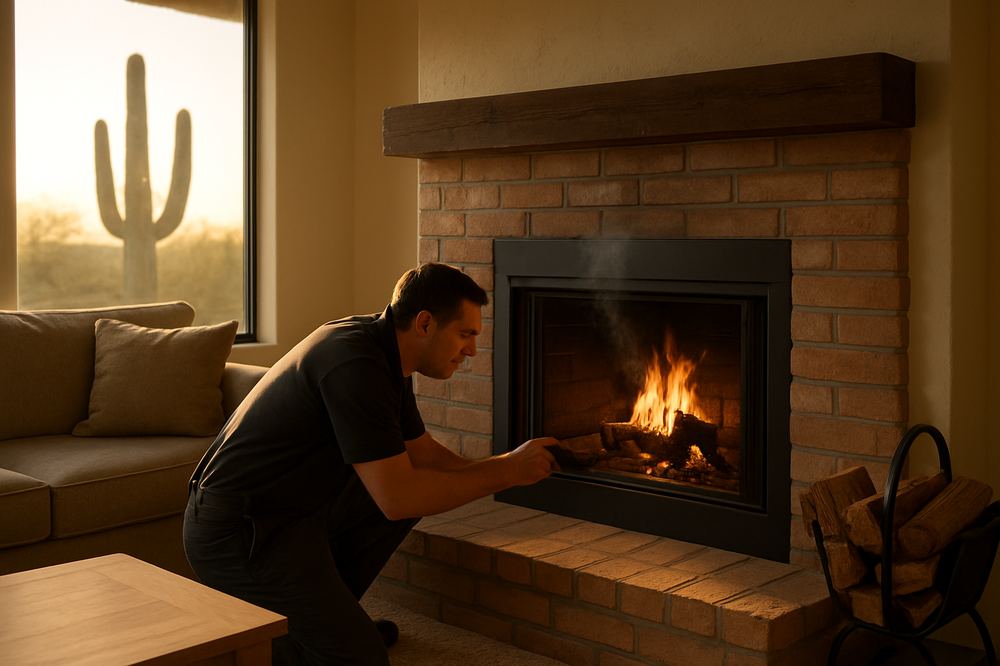
Smoke backing into a Phoenix living room is almost always a neutral-pressure-zone issue in a tight modern home — not a chimney fault. We diagnose it by cracking a window and watching whether the draft reverses.
Smoke comes in when the draft loses
A fireplace works on a simple deal. Hot air rises up the flue, and that rising column pulls smoke up behind it. When the column is strong, smoke goes where it should. When anything weakens it — a cold flue, a half-shut damper, a house fighting for the same air — the smoke takes the path of least resistance, which is your living room.
So the question is never really “why is my fireplace smoking.” It’s “what is killing my draft.” We work through five suspects in the same order on every smoke call, and you can check the first three yourself.
A cold flue that hasn’t started to draft
This is the most common one, and the easiest to miss. A flue full of cold, dense air is a plug — the fire can’t push smoke through it until the column warms up and starts to rise. The first few minutes of a fire are when smoke spills, because the draft hasn’t established yet.
The fix is to prime the flue. Roll a sheet of newspaper, light it, and hold it up near the open damper for thirty seconds before you light the main fire. You’re warming the column so it starts pulling. On a cold Phoenix morning — and our winter mornings get genuinely cold — this single step solves a lot of “my fireplace smokes” complaints.

A damper that’s closed, stuck, or half-open
It sounds obvious. It isn’t — partially open dampers are sneaky, because the fire still draws a little and you assume it’s working. Reach up and feel for the damper plate. Fully open should feel like a clear, unobstructed throat.
In older Valley homes, and especially in retirement communities where fireplaces sit unused for years, the damper seizes from disuse. A frozen or warped damper plate is a real repair, not a wiggle-it-loose job — if yours won’t move freely, that’s worth a look during a chimney inspection in Phoenix rather than forcing it.
Negative pressure — the airtight-house problem
This is the cause people never guess, and it’s the one we find most in newer Phoenix homes. A modern, well-sealed house is in a constant tug-of-war for air. Run a kitchen hood, a bathroom fan, or a clothes dryer, and the house will happily pull its makeup air straight down your chimney — dragging smoke into the room with it.
Homes built after about 2010 are so airtight that wood-burning fireplaces simply struggle to draft against them. We’ve installed exterior air kits on a number of Valley new-builds — roughly $450 to $700 — and the fireplace starts working the way it was designed to. The tell is simple: if the smoking stops the moment you crack a nearby window, the house is starving the fire.
A blocked or dirty flue
If the draft passes the first three checks, the problem is usually up inside the flue. Creosote glaze narrows the passage on wood-burners, and even a thin layer of buildup measurably chokes the draft. Add a bird nest, a pack rat’s stash, or storm debris, and the smoke has nowhere to go but back down.
You can spot the signs from the firebox — dark flakes or shiny glaze on the damper, a strong smoky smell even when cold, fires that are hard to start. The fix is a sweep. Standard chimney cleaning in Phoenix clears the flue and restores the full opening, and we run a Level 1 inspection with every cleaning so we catch a cracked liner or a worn damper at the same time. If creosote has reached Stage 3, that’s a fire hazard, not just a draft nuisance.

An uncapped, undersized, or wind-struck flue
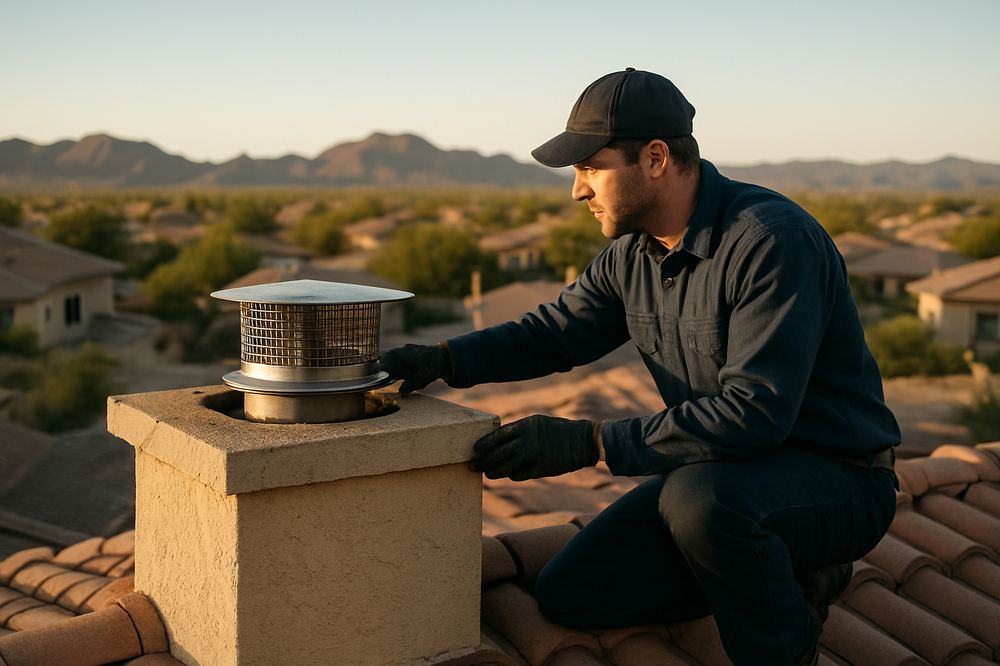
The last suspect lives on the roof. A missing or damaged cap lets rain, animals, and debris into the flue — and on windy days, an uncapped or poorly terminated flue can let gusts blow straight back down the stack. Spring microbursts take caps off Valley roofs every storm season.
Wind-driven smoking has a signature: it only happens on breezy days, and it comes in puffs that track the gusts. The fix is usually a proper cap — sometimes a taller or wind-directional one — and a chimney cap installation in Phoenix runs $150 to $450 installed. While we’re up there we check the crown and flashing too, because a cracked crown that’s letting in monsoon rain is the kind of thing our chimney crown repair guide walks through, and it often rides along with cap problems.
The window test you can run in two minutes
Before you spend a dollar, run this. Crack a window six inches in the same room as the fireplace, then light a small fire or hold a lit match near the open damper. If the smoke straightens up and the spilling stops, your problem is negative pressure — the house, not the chimney. If smoke still rolls into the room with the window open, the flue itself is the issue: cold, blocked, or capped wrong.
That one test sorts the five causes into two camps and tells you whether you’re looking at a free fix or a service call. It’s the same thing we do on the first thirty seconds of a smoke diagnosis.
When it’s a smoke smell, not active smoking
Sometimes there’s no fire at all — just a smoky odor that shows up on certain days. That’s almost always a damper-seal problem combined with negative house pressure. The house pulls air down through the flue and drags old creosote odor in with it, strongest in summer when the air conditioning runs hardest.
A worn damper gasket is the usual culprit, and a replacement gasket fixes most of these for around $150. A top-sealing damper, which seals at the very top of the flue, solves it permanently. If the smell carries an exhaust note from a gas unit, that’s a different and more serious conversation — stop using it and book gas fireplace repair in Phoenix rather than waiting.
What these fixes actually run in the Valley
None of this is exotic. Priming a cold flue and cracking a window cost nothing. A damper gasket runs about $150, an exterior air kit $450 to $700, and a new cap $150 to $450. A standard sweep to clear a blocked flue is $149 to $299.
The expensive outcomes come from ignoring it. A smoking fireplace that’s really a cracked liner or a failing crown turns into chimney repair in Phoenix that climbs fast, and a sooty firebox left alone becomes firebox repair. The honest move is to diagnose first — our $99 diagnostic tells you which of the five causes you actually have, and it credits toward the repair. If you’re curious how a full inspection breaks down, our chimney inspection cost guide lays out the levels, and homeowners in the north Valley can book a chimney inspection in Scottsdale the same week.
Frequently Asked Questions
Why is smoke backing into my house?
The most common causes are a cold chimney that hasn’t warmed up, a closed or partially closed damper, negative pressure in the house from modern tight construction, or a blockage in the flue. Cracking a window when you start a fire often resolves the pressure issue.
Why is there a cold draft coming down my chimney?
A cold draft means the damper is open or the top-sealing damper has failed. Chimneys act as reverse-flow vents when the stack is colder than the house. A damper top-seal solves it permanently; closing a functional damper solves it until next use.
Why does my house smell like smoke when the fireplace isn’t being used?
Nine times out of ten it’s a damper-seal issue combined with negative house pressure. The house pulls air down through the flue, dragging creosote odor with it. Replacing the damper gasket or installing a top-sealing damper usually fixes it for $150-$450.
How do I know if I have creosote buildup?
Signs include a strong smoky smell even when not in use, dark flakes or glaze visible inside the flue or on the damper, difficulty starting fires, or increased smoke in the room. A professional inspection confirms both presence and stage — Stage 3 creosote is a fire hazard.
My gas fireplace smells like exhaust — is that dangerous?
Exhaust or combustion smell indoors from a gas fireplace is a concern — it suggests venting failure, a cracked heat exchanger, or a blocked flue. Stop using the unit and call a professional. CO detectors should be installed in any home with gas appliances, for exactly this scenario.
How much does chimney cleaning cost?
Standard chimney cleaning in the Phoenix metro runs $149 to $299 depending on access, flue size, and how much creosote is present. We include a Level 1 visual inspection with every cleaning.